

Optimization of irrigation management: what factors to keep into consideration?
The goal of irrigation is to ensure a level of soil moisture adequate to guarantee high standards of plant growth and yield, without causing any losses or consuming too much water. A correct irrigation system is crucial for the optimization of crop production.
In this article, we will answer some of the most important questions regarding optimal irrigation:
01. How much water should I apply?
To answer this question, we need to keep in mind that the amount of water required to satisfy the plant’s requirements depends on several factors, such as the properties of the plant, soil and climate. To achieve optimal results, a recommended approach is to consider all the factors playing a role.
Let’s see them more in detail:
Plant evapotranspiration:
Evapotranspiration is the most important factor in water management. It refers to the water that is transferred from the plants and the soil to the atmosphere in the form of vapor. From a production point of view, the amount of water lost by evapotranspiration to produce 1 kg of product represents our water requirement target. See the detailed explanation for more info about ETc (plant evapotranspiration).
Understanding plant evapotranspiration:
With evapotranspiration, we refer to the measurement of the evaporation of water from the soil (wet and dry) and transpiration from the crop of interest and, when present, cover crops. Evapotranspiration represents the most significant component of water balance for an orchard. The plant evapotranspiration (ETc) is calculated as:
ETc = ET0 x Kc
where:
- ET0 is the reference evapotranspiration and refers to the amount of water lost in the atmosphere in optimal water conditions from a vegetated area through the evaporation from the soil and the transpiration from the plant. It can be identified through direct (more precise, but more complicated) or indirect measurements. Among indirect measurements, the Penman-Monteith equation is generally recommended, given its simplicity of use. However, it does need climatic information (humidity, temperature min, max, avg, speed and direction of wind, net radiation, heat flux from the soil).
- Kc is the crop coefficient, which considers the plant evapotranspiration and the developmental stage. Kc varies during the season and during the years as it is affected by the water requirement of the crop, plant canopy size, the climate and by the vegetation density. Tabulated values of Kc can be found online and can be adapted to the field conditions.
Once we have Kc and ET0, we can calculate ETc. Therefore, evapotranspiration depends on climatic factors, plant characteristics and field conditions.
Soil:
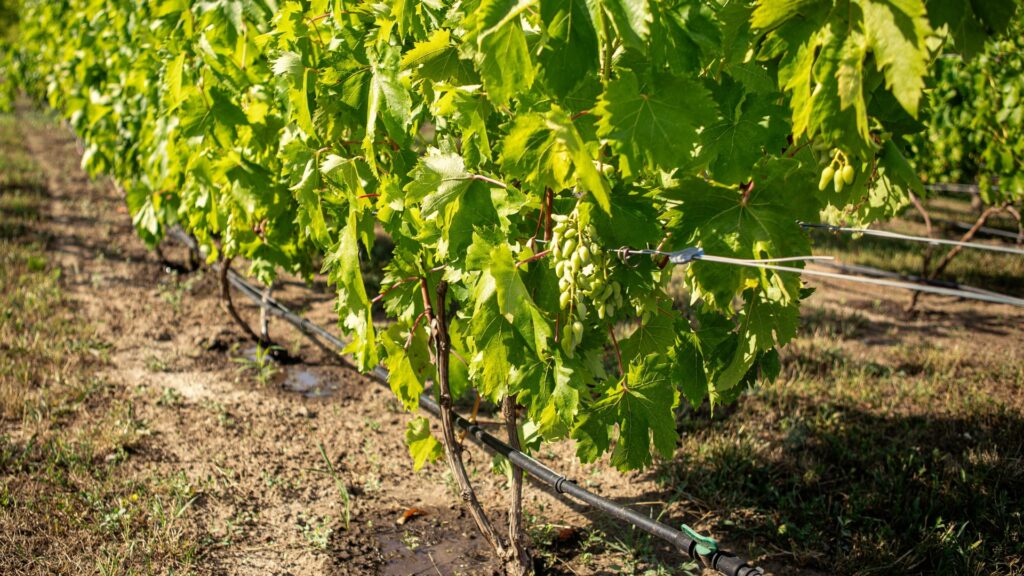
Irrigation is considered efficient when the water we supply reaches the roots, without getting lost by leaching, or runoff, or creating problems of waterlogging. When planning and managing the irrigation system, it is therefore important to consider the properties of our soil. The soil’s ability to store water (soil water holding capacity) and to be infiltrated by water (soil water conductivity) depend on the soil type, the soil slope, the soil organic matter, as well as the orchard management.
Clay soils have higher holding water capacity but low water conductivity, which makes them more likely to store water after irrigation or rainfall, but also to have slow infiltration, causing runoff and/or waterlogging. Sandy soils, while having lower holding capacity, have high infiltration rate and water conductivity, which make them prone to loss of water by leaching. Grass-covered orchards, and soils with particularly high organic matter content, generally show high water holding capacity and high-water infiltration. Soils with steep slopes are subject to runoff.
Moreover, it is important to remember that generally soil is not perfectly uniform within the orchard: soil texture, vegetation density, and/or presence of slopes can be spatially different. When evident differences are present, dividing our fields into different zones with similar properties, so that management can be tailored to them, can be useful to achieve optimal results.
Climatic data:
In areas where rain is rare, it goes without saying that irrigation will play a bigger role than in areas that receive frequent rainfall. In any case, even where it rains frequently, the amount of rain actually intercepted by roots depends on the soil type, depth of root system, presence of slopes and/or grass-covered soil, for which irrigation is generally needed.
To evaluate plant evapotranspiration and the evaporation from the soil, it is important to also consider the average temperatures, air humidity, the intensity of wind and the light radiation. Different weather stations can be used for monitoring the climatic parameters, such as Davis, Sencrop and METOS.
Quality of water:
While this is often an underlooked parameter, the quality of water in terms of physical, chemical and biological properties is another component of irrigation efficiency.
For this reason, testing the water is strongly recommended to avoid any problems of plant toxicity or nutritional imbalances. Specific cultures, such as almond, avocadoes and citrus trees, are particularly susceptible to salinity, making checking the quality of water essential.
On top of that, the accumulation of salts can clog the nostril of the irrigation system and lead to problems and more maintenance.
Efficiency and uniformity of distribution of the irrigation system.
This depends on factors such as the type of irrigation used, irrigation maintenance, as well as the presence of slope or uneven surfaces. Frequent monitoring and maintenance of the system need to be provided.
02. When should I apply water?
Knowing the phases in which our crops are particularly susceptible to water stress is useful to plan ahead for water supply. It can also guide us in the Deficit Irrigation, which becomes particularly interesting for those areas with limited access to water for irrigation.
Water soil probes can help us to take prompt action in the moment of need and avoid plant water stress. Recommended options are the one offered by Decagon Devices and Sentek.
03. How can I apply water?
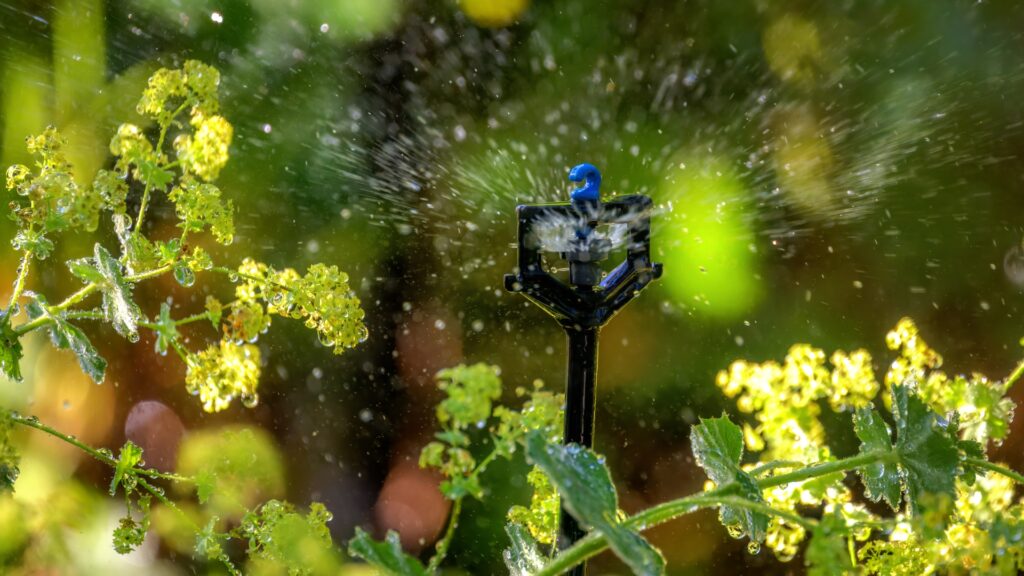
There are multiple irrigation systems available. The majority of orchards rely on precision irrigation systems such as micro sprinklers or drip irrigation, as they guarantee high water use efficiency.
The way that water is distributed in the soil around the emitter (soil wetting pattern) varies based on the type of irrigation system chosen and the type of soil. This needs to be evaluated when choosing the irrigation system and management plan to ensure the selection of the most suitable irrigation system for the plant roots system.
It is also very important to consider that the plant root system is constantly evolving, so the irrigation management (water flow rate, the frequency of application, the distance between the nostrils etc) should be planned accordingly.
04. How to evaluate the efficacy of irrigation?
There are several ways to tackle this:
- Water Use Efficiency refers to how much of the water applied is converted into crop yield. A higher value reflects higher performance.
- Lower levels of plant water stress indicate good irrigation management.
- Soil probes can also help us monitor soil moisture and guarantee enough water to sustain our crops.
05. To summarize
To summarize, to reach optimal irrigation management, consider the following:
- Crop water requirement
- Soil properties
- Climatic data
- Irrigation system efficiency
While considering these factors adds a significant level of complexity, it guarantees efficiency and optimization of the water supply.
Today, there are a lot of technologies that can guide us towards optimal irrigation performances. Wiseconn is a platform specialized in irrigation management that provides full monitoring and control of the entire irrigation process, making these steps easier.