
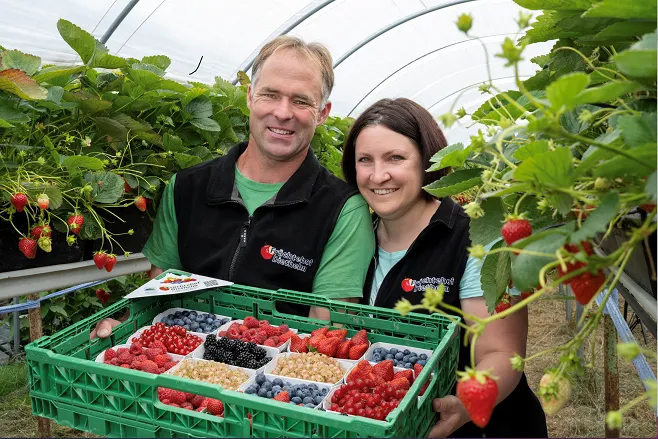
- Fruchthof Diethelm has been in the Diethelm family since 1923, now managed by Kilian and Sandra Diethelm across 7.5 hectares of pome fruit, stone fruit, and berries, with 70 sub-plots above Lake Zurich.
- Paper spray records across that many plots and varieties were time-consuming and difficult to manage accurately. Since 2021, Farmable has replaced them entirely.
- Switzerland's DigiFLUX digital reporting requirement is coming, and Fruchthof Diethelm is already digitally prepared. "The big win is the simplicity of the app."
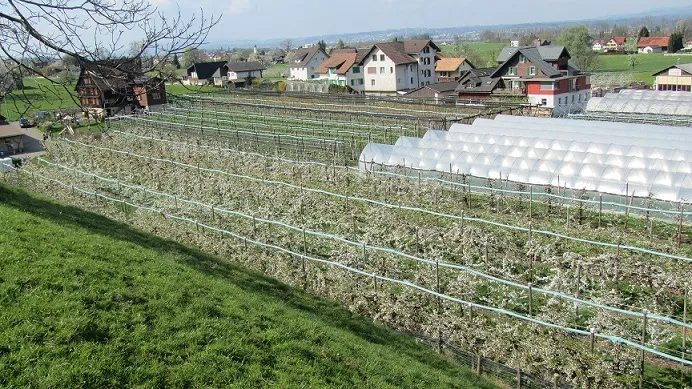
Fruchthof Diethelm is perched 440 metres above sea level, overlooking Lake Zurich. The 7.5-hectare farm grows pome fruit, stone fruit, and a wide variety of berries across 70 sub-plots, a complex, multi-variety operation with an equally long history.
The farm has been in the Diethelm family for more than 100 years. It was acquired in 1923 by Kilian's grandparents, Berta and Josef Diethelm, who ran a dairy operation on the property. Kilian's parents, Josef and Heidi, took over in 1971 and expanded into pig farming through the 1980s. When the milk price collapsed in the early 1990s, the family faced a significant decision, and chose to focus on what offered the highest potential for the property: fruit and berry production with direct sales to local customers and businesses.
The first cherry trees and strawberries were planted in 1994. Apples, pears, and plums followed in 1995. Today, Fruchthof Diethelm operates its own farm shop selling locally produced food, including a range of fresh and processed fruit products grown on the property.
Kilian and Sandra Diethelm have managed the farm since 2003, steadily expanding the range of varieties grown and advancing the technologies used in the field.
Swiss standards and the compliance reality
Switzerland holds high standards for food production, and Fruchthof Diethelm takes compliance seriously. The farm operates under Suisse Garantie, a rigorous standard that verifies quality assurance across the entire production chain, with regular checks by independent control bodies. The farm also undergoes an additional compliance process to verify produce meets requirements for local food labels, managed by the area canton.
Looking ahead, Switzerland is implementing the 2021 parliamentary initiative "Reducing the risk of pesticide use." The Federal Office of Agriculture (BLW / FOAG) has initiated DigiFLUX, a digital reporting system for farms to submit their plant protection product use, with mandatory adoption expected for Swiss farms. Farmable is developing a direct integration with DigiFLUX to ensure Swiss farmers can meet this requirement from within the app.
Fruchthof Diethelm is already prepared.
Simplifying compliance across 70 sub-plots
With many fruit varieties and 70 sub-plots to manage, accurately documenting crop treatments on paper was time-consuming and difficult to do well.
“It's a very detailed recording, which isn't easy on paper.”
Kilian Diethelm
In 2021, Kilian downloaded Farmable and started testing how he could use it to manage spray treatments. The result was immediate.
“I felt a huge relief. I could calculate and document the spraying work straight away.”
Kilian Diethelm
He invited all his employees to use the app, making it easy to collect as much data as possible across the whole team, enabling better decisions for the farming business.
Beyond spray records, Farmable also reduced the administrative effort required to demonstrate the harvest origin of produce grown at Fruchthof Diethelm. In the app, Kilian and his team record field location, variety, and box count of harvested produce from a mobile device. With this data, the farm can readily verify requirements for local labelling standards, proving the fruit comes from their own production and is not purchased externally.
What makes Farmable work for a complex Swiss farm
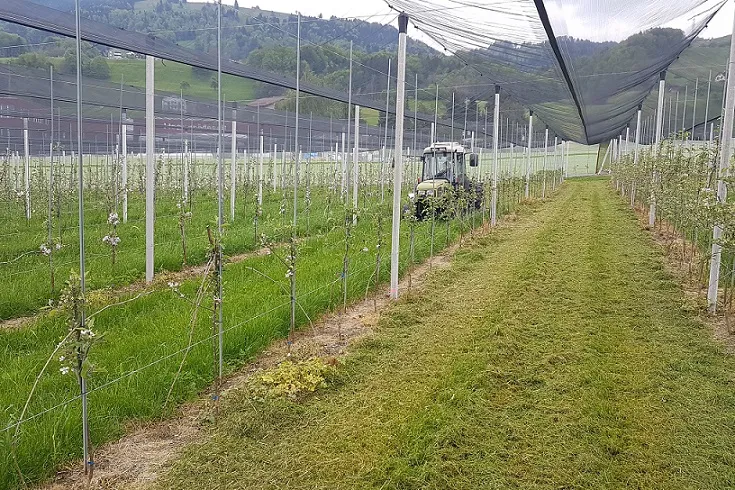
Fruchthof Diethelm is not a simple operation. Seventy sub-plots, multiple crop categories, a demanding compliance environment, and a team that needs to work efficiently in the field, all of this requires a tool that doesn't add to the administrative burden.
“The big win is the simplicity of the app.”
Kilian Diethelm
Today, Kilian uses weather data from Agrometeo alongside Farmable records. In the future, weather data and pest and disease metrics will become an integral part of demonstrating alignment with Integrated Pest Management (IPM). Being able to pull reports combining data from multiple sources in one tool, and share them easily with authorities, will be essential to avoid drowning in paperwork as requirements evolve.
Three generations building for the next
Three generations of farmers are responsible for the success at Fruchthof Diethelm today. Each generation has transformed the business to stay relevant and profitable in its time.
Kilian and Sandra are building the foundation for the next generation with the same forward-thinking approach, digital records already in place, compliance processes already running, and a data set that grows in value with every season.
Frequently asked questions
What is DigiFLUX and when does it apply to Swiss farms?
DigiFLUX is the Swiss federal digital reporting system for plant protection product use, being developed by the Federal Office of Agriculture (BLW / FOAG). It is expected to become mandatory for Swiss farms. Farmable is developing a direct DigiFLUX integration, confirm the current timeline with the Farmable team.
Does Farmable work for Swiss farms with local food label requirements?
Yes. Farmable records harvest data at the field, variety, and box level, making it straightforward to verify origin requirements for local labels and demonstrate that produce is grown on the farm rather than purchased externally.
Can Farmable handle a farm with many small plots?
Yes. Fruchthof Diethelm manages 70 sub-plots across 7.5 hectares. Farmable allows farms to be mapped and managed at any level of complexity, individual plots, crop categories, or varieties, with all treatments and harvest data attached to the specific areas they relate to.