Recorded when the work is done
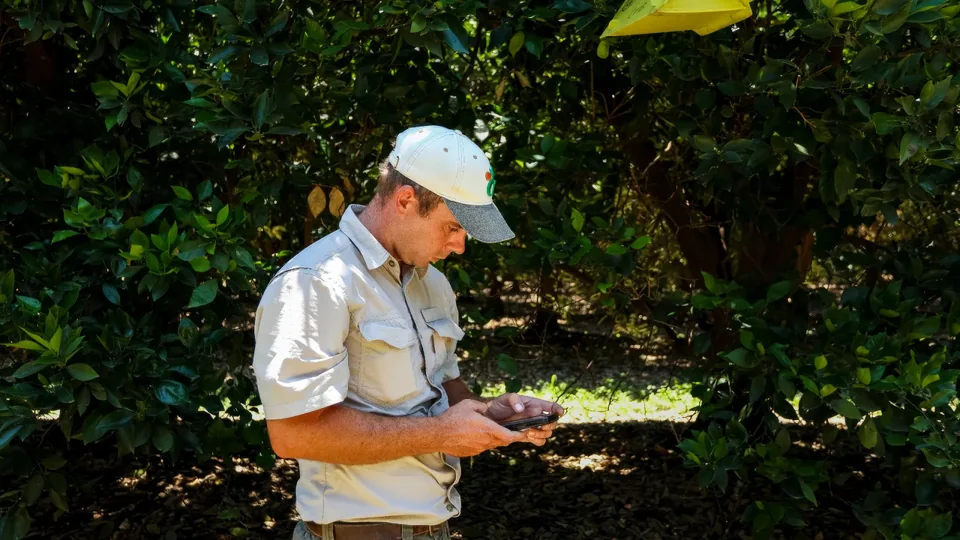
Workers log sprays, fertiliser and harvests in the app as each job is finished. Date, field, product, operator, GPS and weather are added to every job.

Growers record sprays, fertiliser, harvests and team hours in Farmable as the work happens. ESG, carbon and compliance platforms can use those records, with the grower's consent, instead of asking farms to fill in spreadsheets.
Talk to us about a data partnershipUsed by 2,100+ farms across 18 countries. Farm data stays owned by the farm it comes from.
Farmable captures the activity data behind ESG and carbon reports: what was applied, where, when, and how much was harvested. Your platform applies its own methods and emission factors. The grower approves what is shared.
Workers log sprays, fertiliser and harvests in the app as each job is finished. Date, field, product, operator, GPS and weather are added to every job.
Every farm uses the same fields, products and job types, so data from many farms lines up without cleaning.
The farm owns its data, chooses which partners can see it, and can export it at any time.
Production volume, yield per hectare, crop protection and fertiliser use, and workforce hours, per farm and per season.
Crop protection and fertiliser inputs, plus kilos harvested, give your calculator what it needs for emissions per hectare and per kilo produced. Farmable does not calculate carbon itself. Your tool keeps its own emission factors.
The same spray, fertiliser and harvest records growers keep for GLOBALG.A.P. audits can feed your compliance reports, so nothing is entered twice.
Input records per field, season after season, show how fertiliser and crop protection use changes over time. Practice data such as cover crops and tillage is not in Farmable yet. Tell us if your programme needs it.
ESG and carbon platforms ask for much of the same farm data. Here is honestly where Farmable stands on each.
Farmable already records this data.
The records exist. One extra detail is needed.
Not recorded in Farmable today. These usually come from utility bills, packhouse systems or other tools.
Teams and timesheets and sales are Farmable Pro add-ons, so this data exists only for farms that use them.
Start with the metrics that are ready today.
Match Farmable records to your input format. Agree units, crop names and your reporting year.
Decide how to carry nutrient content, bearing status and product categories.
Set up data access, data terms, and how each grower approves sharing with you.
Connect two or three farms for one production year and compare the results with your current reports.
Crop Compliance, a compliance consultancy and software provider for South African farms, packhouses and cellars, already receives Farmable field and spray records automatically.
About the partnership →No. Farmable records the activity data, such as crop protection, fertiliser and harvest volumes. Your platform applies its own emission factors and calculations.
The farm owns its data. Each grower chooses which partners can access it, and nothing is shared without their approval.
Through the Farmable API or a dedicated integration, agreed during the partnership. See the API documentation for technical details.
Yes, for input use. Fertiliser and crop protection records per field show change over time. Practice data such as cover crops, tillage and soil carbon is not recorded in Farmable today.
Yes. Every farm uses the same data structure, and the Enterprise portal links 2 to 20,000 farms under one company or co-op.
Tell us. We are open to adding data that saves growers time and gives them something useful back.
For product and integration teams.
fields and blocks (area, crop, variety, mapped boundaries); plantings (plant dates); spray jobs (product, product type, rate, treated area, water volume, cause, date, operator, GPS, weather); fertilise and fertigate jobs (product, rate, area, date); harvests (kilos per field and variety, date); teams and timesheets (hours per worker and task).
every farm uses the same fields, products and job types. Units are agreed during field mapping. The season start date on each farm aligns records with your production year.
data is shared per farm, only after the grower approves. Data terms are agreed with each partner.
Data not yet in the public API can be added for a partner integration.
farms on Farmable Pro can export records as CSV, XLSX and PDF.
Tell us about your platform and the data your reports need. We'll show you what Farmable can provide today, what we can add, and what we'd need to build.